If you make automated credit decisions in Singapore, the FEAT principles have been your benchmark since 2018: Fairness, Ethics, Accountability and Transparency. For most of that time they were exactly what they said they were, principles. 2026 is the year they grow teeth.
What do the FEAT principles actually require?
FEAT asks four things of any AI-driven decision that affects a customer.
- Fairness: the personal attributes your models use must be justified, and the models regularly tested for unintended bias.
- Ethics: automated decisions must be held to at least the standard you would apply to a human making the same call.
- Accountability: a named owner inside the firm answers for the decision, and the customer has a channel for recourse.
- Transparency: the use of AI is disclosed, and a customer can get an explanation of a decision that affected them.
For credit decisioning that last pair does the heavy lifting. A declined applicant is entitled to something better than “the model said no”. The Veritas consortium spent years turning these principles into assessment methodologies, so “we didn’t know how to measure it” has not been a defensible answer in Singapore for some time.
What changed in 2026?
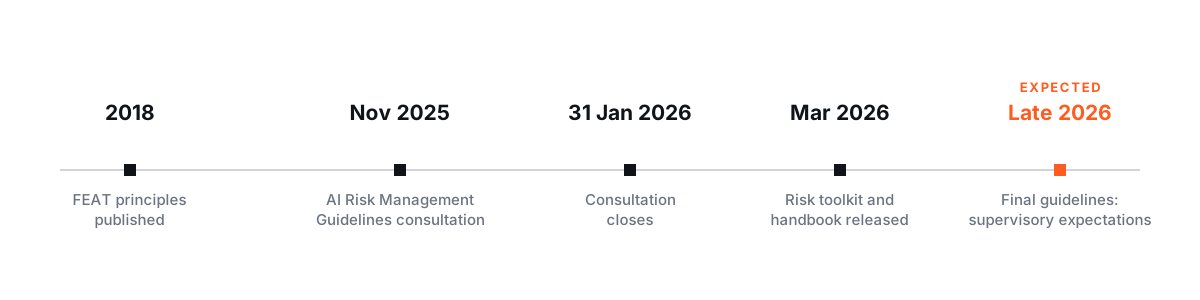
In November 2025 MAS released a consultation paper on Guidelines on AI Risk Management, with the consultation closing on 31 January 2026. In March 2026 it followed with an AI risk management toolkit, including an operationalisation handbook that translates the principles into concrete actions. The finalised guidelines are expected later this year, applying across financial institutions: banks, insurers, capital markets intermediaries and payment providers.
The important shift is in status. Guidelines of this kind function as supervisory expectations, which means MAS can assess your AI governance during inspections and thematic reviews. The era of principles you could nod along to is ending; what replaces it is evidence you can be asked to produce.
What does “explainable” mean for a credit decision?
In practice, an explainable credit decision has five properties. The reasons are captured at the moment of decision, not reconstructed afterwards. The policy and model version that produced the decision are recorded, so the same question gets the same answer months later. The explanation exists in customer language, not model language: “declined because verified income does not meet the serviceability threshold for the amount requested”, not a feature importance chart. Low-confidence and high-impact cases route to a human with full context. And the whole trail is queryable when the regulator, or the customer, asks.
None of that is a property you can bolt onto a black box afterwards. It is an architectural choice, which is why we built CxOS to carry every decision’s reasons with it from the start.
What should you do before the guidelines land?
Four things:
- Inventory every AI-driven decision that affects customers; most firms find more than they expected.
- Assign a named owner to each.
- Test whether your current systems can produce a decision-level explanation for something that happened six months ago, because that is the question an inspection asks.
- Treat the March 2026 operationalisation handbook as a self-assessment checklist now, rather than a compliance exercise later.
Sixteen months of consultation runway has already been spent. Firms selling into Singapore’s banking and insurance sectors should expect FEAT-shaped questions in procurement well before the guidelines are final, for the same reason CPS 230 controls appeared in Australian contracts early: regulated buyers de-risk ahead of their regulator.